Agentic AI with MCP, LangChain & LangGraph: Building Enterprise Agents That Ship Safely
A practical guide to agentic AI for enterprise teams — Model Context Protocol (MCP), LangChain tool wiring, and LangGraph stateful workflows. Learn how to build agents with guardrails, audit trails, and production-ready tool access.
- Agentic AI
- MCP
- LangChain
- LangGraph
- Enterprise AI
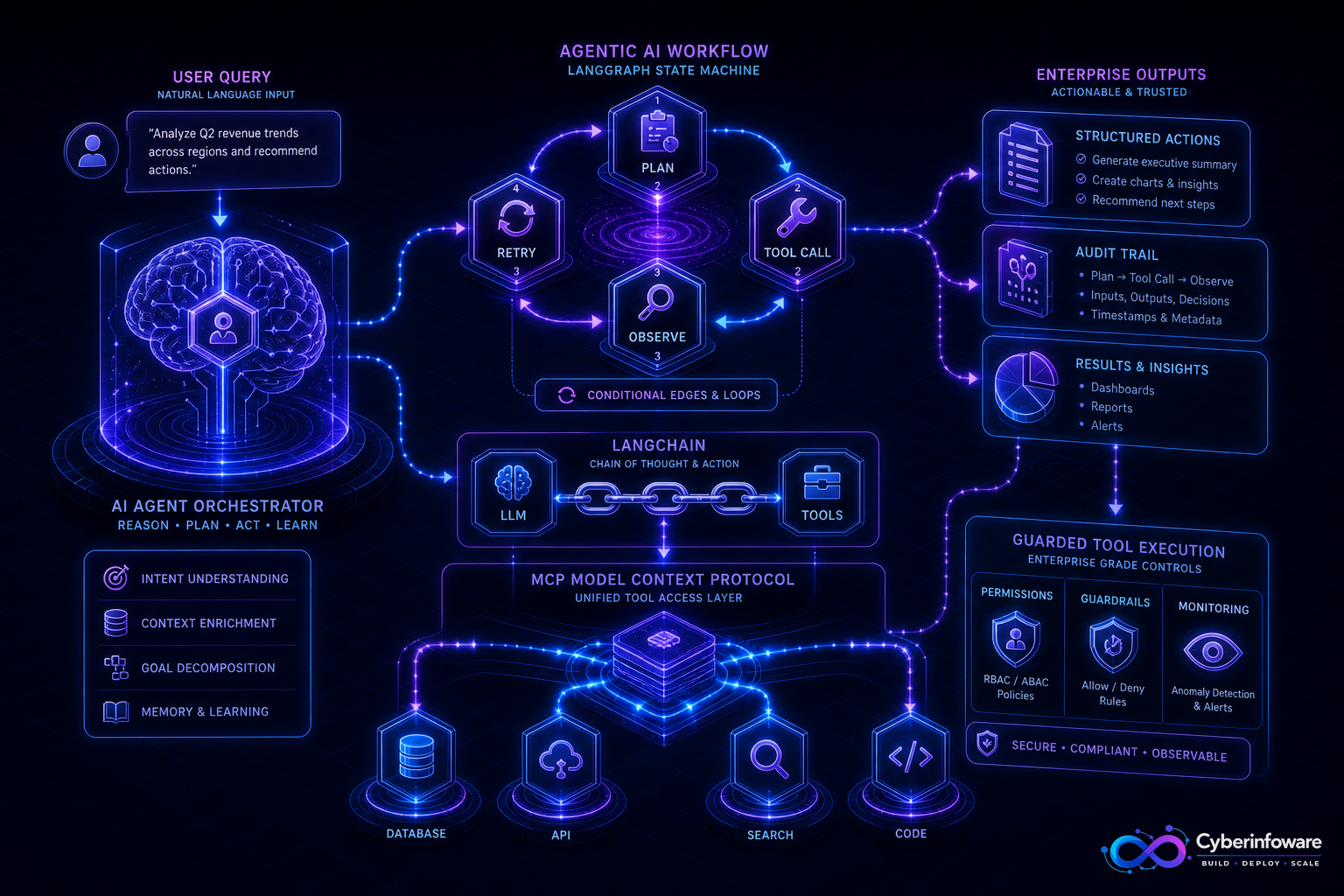
Agentic AI is not a chatbot with extra steps. It is a system where an LLM plans, calls tools, observes results, and loops until a goal is met — querying a database, filing a ticket, summarizing logs, or orchestrating a multi-step SaaS workflow. The stack that makes that tractable in production is MCP for standardized tool access, LangChain for composable chains and tool bindings, and LangGraph for explicit state machines that survive retries, human approval, and long-running tasks.
This guide explains how those pieces fit together for enterprise teams, what to build first, and where Cyber Infoware helps — from AI consulting and agent architecture to production NestJS SaaS platforms that agents can safely call into.
Why one-shot prompts fail in the enterprise
- Real work spans multiple systems — CRM, billing, internal APIs, knowledge bases
- Models hallucinate when they cannot verify facts against live data
- Unbounded agent loops burn tokens, time, and trust
- Compliance needs an audit trail: which tool ran, with what input, under whose identity
MCP, LangChain, LangGraph — who does what
- MCP (Model Context Protocol) — a standard way for agents to discover and invoke tools (files, APIs, DBs) through MCP servers; swap tools without rewriting the agent core
- LangChain — chains, retrievers, and tool-calling wrappers that connect models to MCP or native tools with structured prompts and parsers
- LangGraph — a graph/state-machine layer: nodes for LLM steps, tool nodes, human-in-the-loop, checkpoints, and conditional edges when something fails
A minimal agent loop
- User goal arrives with tenant/user context
- Planner node decides next action (answer, call tool, ask human)
- Tool node runs via MCP with scoped credentials
- Observer node ingests result; graph routes to retry, branch, or complete
- Final response includes citations or tool trace for support and compliance
Production guardrails that matter
- Tool allowlists — agents only see MCP tools you explicitly register
- Identity passthrough — agent actions run as the user or a scoped service account, not god-mode API keys
- Budgets — max steps, max tokens, max wall-clock time per run
- Human approval — LangGraph interrupt nodes for destructive or high-risk operations
- Structured logging — every tool call logged with correlation id; no raw secrets in traces
- Evals — golden tasks in CI so prompt/graph changes do not silently regress
An agent without tool boundaries and audit logs is not enterprise AI — it is an expensive autocomplete with side effects.
When to use LangGraph vs a simple chain
- Simple chain — one retrieval + one answer; no branching
- LangGraph — multi-step research, parallel tool calls, retries, sub-agents, or approval gates
- MCP everywhere — when the same tools must work in Cursor, internal copilots, and batch jobs
- Start linear; add graph complexity only when loops and state become unavoidable
Enterprise SaaS patterns
- Tenant-scoped MCP servers — one customer's data never leaks into another's tool context
- Read-only tools first; write tools behind RBAC and confirmation
- Pair agents with existing audit and webhook pipelines in NestJS microservices
- Cache embeddings and tool metadata; do not re-fetch on every graph step
What "done" looks like
An internal copilot answers from live data via MCP, a LangGraph workflow completes a three-step ops task with one human approval, and every tool invocation is traceable. That is agentic AI that enterprises can adopt. Explore Cyber Infoware products or contact us for AI consulting, agent architecture, or a SaaS foundation agents can trust.
Explore Cyber Infoware packages
Production NestJS SaaS foundations with commercial licensing — pick the architecture that matches your team.
- NestJS Microservice Starter Kit
Production NestJS microservices — API gateway, Keycloak SSO, RabbitMQ, Docker, Kubernetes, and Terraform.
- Enterprise SaaS Microservices Boilerplate
Full multi-tenant SaaS control plane as NestJS microservices — service-per-DB, billing, audit, notifications.
- Multi-Tenant SaaS Boilerplate
Best-seller NestJS multi-tenant SaaS boilerplate — one API, per-tenant databases, billing, and Keycloak SSO.