Event-Driven Architecture with RabbitMQ: Decouple NestJS Microservices Without Blocking Requests
A practical event-driven architecture guide using RabbitMQ — producers, exchanges, queues, and consumers for NestJS SaaS. Learn topic routing, retries, idempotency, and how Cyber Infoware kits wire the pattern end to end.
- Event-Driven
- RabbitMQ
- NestJS
- Microservices
- Architecture
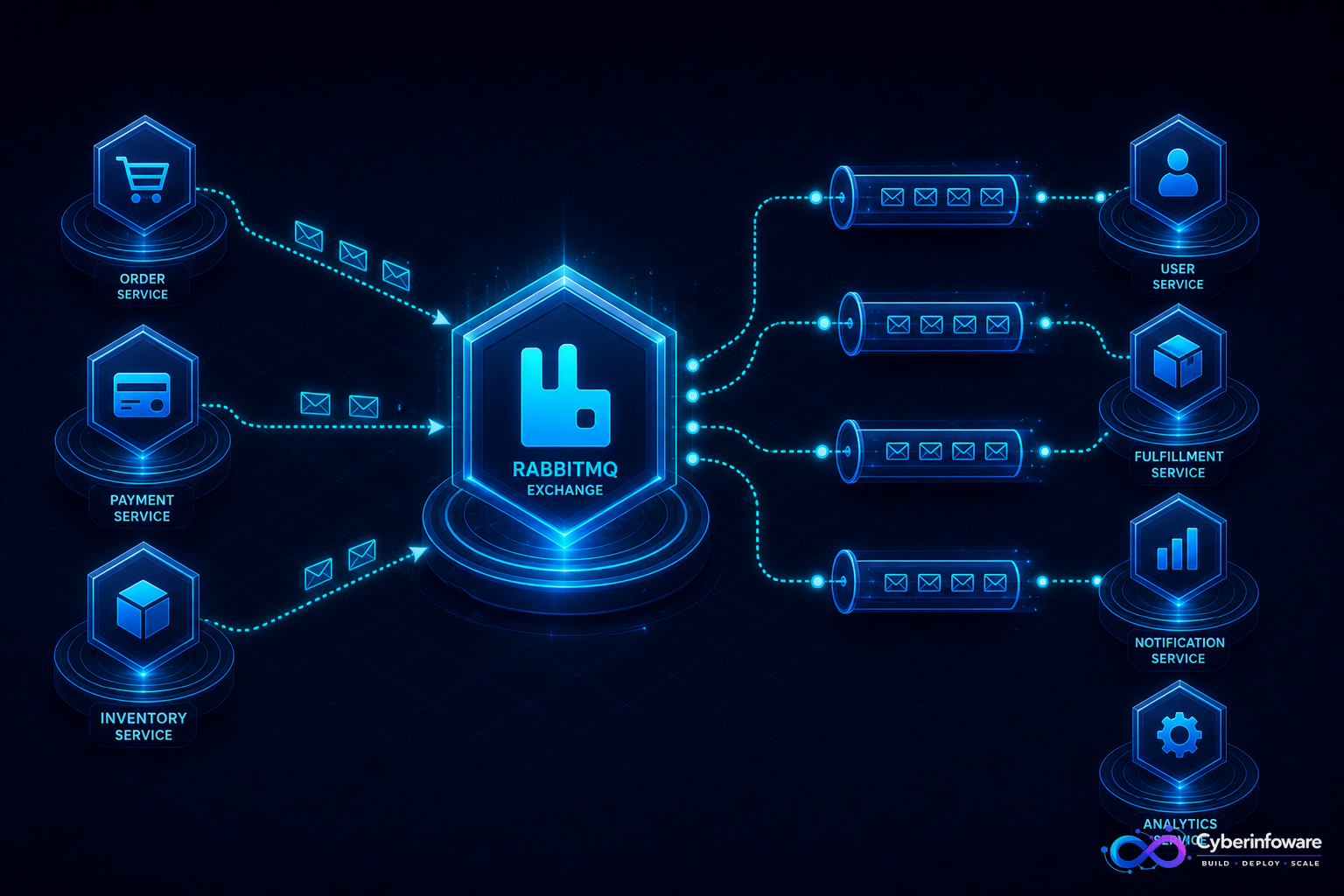
Event-driven architecture lets services react to facts that already happened — order placed, tenant created, invoice paid — without chaining every side effect into one slow HTTP call. A message broker sits in the middle: producers publish events, consumers process them asynchronously, and the user gets a fast response while email, audit, and analytics catch up in the background.
In NestJS SaaS platforms, RabbitMQ is a common choice for that broker. This guide walks through producers, exchanges, queues, and consumers — and how Cyber Infoware kits ship the pattern wired end to end instead of as a slide-deck diagram.
The RabbitMQ mental model
- Producer — a NestJS service publishes an event after a successful domain action (e.g. order confirmed)
- Exchange — RabbitMQ routes the message by routing key (direct or topic exchanges are common)
- Queue — a durable buffer for one consumer group (notifications, audit, analytics)
- Consumer — a worker that reads the queue, does the work, and acknowledges the message
Why sync APIs are not enough
Checkout should not wait on SMTP. Creating a tenant should not fail because a reporting job is slow. Event-driven design keeps the request path thin: validate, persist, publish, return. Side effects become consumers that can retry, scale independently, and fail without breaking the original transaction — as long as you design for at-least-once delivery and idempotent handlers.
A practical SaaS event flow
- API gateway / order service accepts the request and writes the domain record.
- Service publishes `order.created` (or similar) to a RabbitMQ topic exchange.
- Notification queue receives the message and sends email / in-app alerts.
- Audit queue writes an immutable trail for compliance and debugging.
- Analytics or billing consumers update aggregations without blocking checkout.
- Failed messages go to a dead-letter queue for inspection and replay.
Exchanges and routing keys
A direct exchange matches exact keys (`order.created`, `order.paid`); a topic exchange can also match patterns like `order.*`. Either way, one publish can fan out to several queues. Keep routing keys stable and version event payloads carefully — consumers should ignore unknown fields and treat missing fields as optional when possible.
Idempotency is not optional
Brokers redeliver. Network blips happen. Consumers must tolerate duplicates: store a processed event id, use upserts, or make side effects safe to replay. Without that discipline, “async” becomes “double emails and double charges.”
Design tips for NestJS microservices
- Publish only after the local DB commit succeeds — or use an outbox if you need stronger guarantees
- Prefer small, clear event names over dumping entire aggregates into every message
- Separate sync commands (RPC / HTTP) from async events so APIs stay predictable
- Monitor queue depth and consumer lag the same way you watch HTTP latency
- Use dead-letter queues and alerts instead of silent drops
When a unified API is still smarter
Early products often ship faster with a unified NestJS API and clear module boundaries — then introduce RabbitMQ when independent scale, retries, or multi-service ownership become real. Event-driven architecture is a tool for decoupling, not a requirement on day one.
What “done” looks like
A user action returns quickly; background work lands in RabbitMQ queues; consumers process, retry, and dead-letter safely; and you can explain every side effect from a routing key. That is the bar for production event-driven NestJS SaaS. Explore packages on cyberinfoware.com or contact us to match a kit to your messaging goals.
Explore Cyber Infoware packages
Production NestJS SaaS foundations with commercial licensing — pick the architecture that matches your team.
- NestJS Microservice Starter Kit
Production NestJS microservices — API gateway, Keycloak SSO, RabbitMQ, Docker, Kubernetes, and Terraform.
- Enterprise SaaS Microservices Boilerplate
Full multi-tenant SaaS control plane as NestJS microservices — service-per-DB, billing, audit, notifications.
- Multi-Tenant SaaS Boilerplate
Best-seller NestJS multi-tenant SaaS boilerplate — one API, per-tenant databases, billing, and Keycloak SSO.