Microservices Architecture Patterns with NestJS: Gateway, Events, and Service Boundaries
A practical NestJS microservices architecture guide — API gateway, RabbitMQ events, service-per-database, Redis, and how requests flow from clients to independent services.
- Microservices
- NestJS
- RabbitMQ
- Architecture
- API Gateway
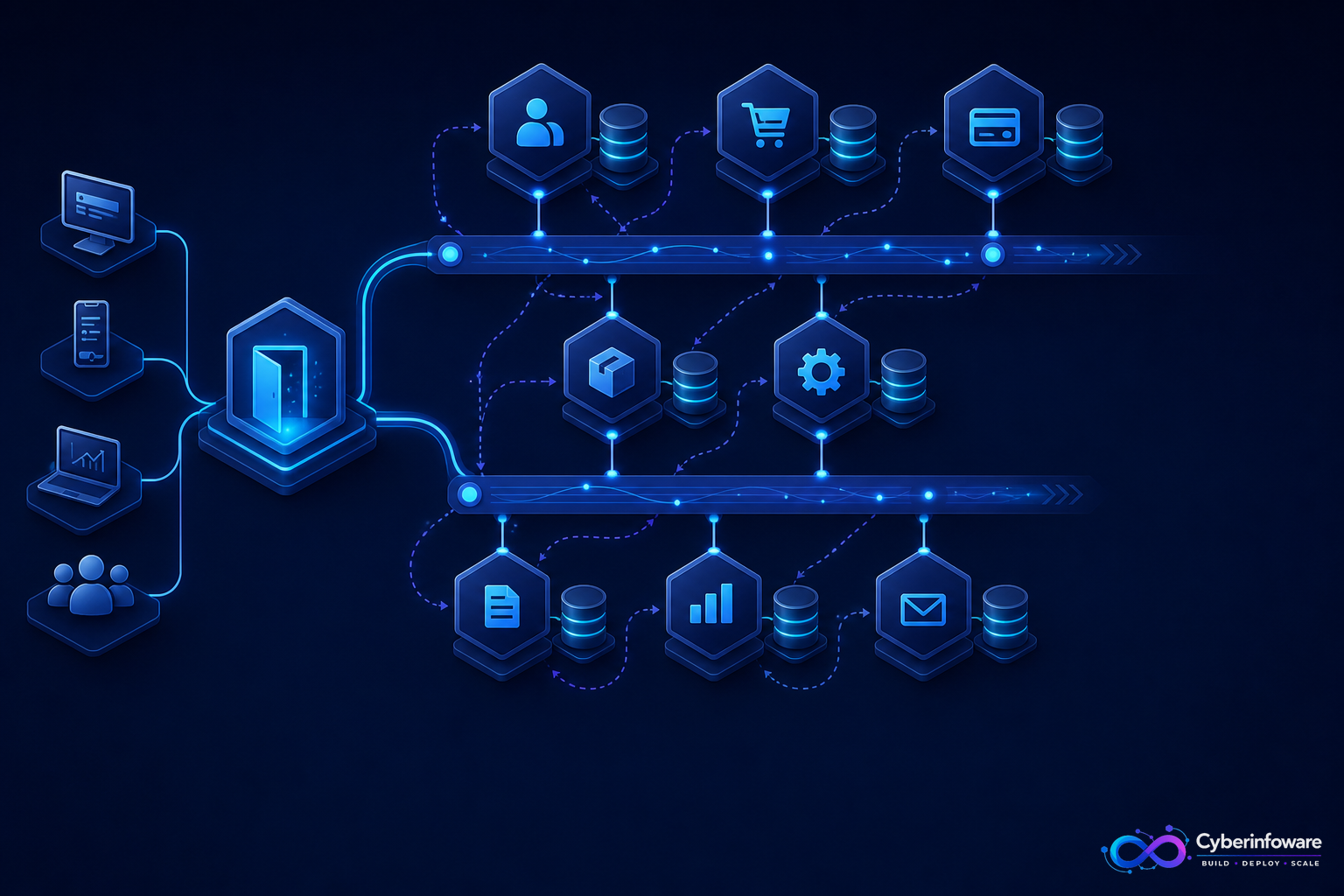
Microservices split a system into independently deployable services owned by clear domains. In NestJS, that usually means an API gateway at the edge, domain services behind it, async events over a broker (often RabbitMQ), and careful data ownership so you do not recreate a distributed monolith.
This article maps the patterns that show up in production NestJS SaaS platforms — and where Cyber Infoware’s Starter and Enterprise kits already encode them.
The request path at a glance
- Client calls a public URL (often via load balancer + TLS termination).
- nginx / Ingress forwards to the API gateway service.
- Gateway validates JWT (e.g. Keycloak), applies rate limits / routing.
- Gateway calls the right NestJS service synchronously — or publishes an event for async work.
- Each service uses its own database (or schema) and replies / emits follow-up events.
Pattern 1: API gateway as the single front door
Clients should not know every internal service URL. The gateway centralizes auth, routing, and cross-cutting concerns. Internally you still keep domain services small — tenant, billing, catalog, notifications — without exposing them to the internet.
Pattern 2: Service-per-database
If every service shares one database, you only pretended to split. Service-per-database (or at least strict schema ownership) keeps blast radius small and lets teams migrate independently. Multi-tenant SaaS often combines this with tenant isolation strategies at the data layer.
Pattern 3: Events for workflows
After checkout succeeds, send email, write audit, update analytics — asynchronously. RabbitMQ (or similar) decouples those steps so a slow mail provider does not fail the HTTP response. Design idempotent consumers; at-least-once delivery is normal.
When a unified NestJS API is smarter
Early teams often move faster with modular monolith / unified services that still model tenancy and billing clearly. You can graduate to microservices when independent deploy and scale become real constraints — not slide-deck aspirations.
Compare architectures on cyberinfoware.com or ask via contact.
Explore Cyber Infoware packages
Production NestJS SaaS foundations with commercial licensing — pick the architecture that matches your team.
- NestJS Microservice Starter Kit
Production NestJS microservices — API gateway, Keycloak SSO, RabbitMQ, Docker, Kubernetes, and Terraform.
- Enterprise SaaS Microservices Boilerplate
Full multi-tenant SaaS control plane as NestJS microservices — service-per-DB, billing, audit, notifications.
- Multi-Tenant SaaS Boilerplate
Best-seller NestJS multi-tenant SaaS boilerplate — one API, per-tenant databases, billing, and Keycloak SSO.