Rate Limiting in NestJS for Multi-Tenant SaaS: Throttling, Quotas & Abuse Prevention
A practical NestJS rate limiting guide for multi-tenant SaaS — throttling at the gateway, Redis-backed counters, per-tenant quotas, and abuse protection. Learn what to limit first and how Cyber Infoware kits ship a production-ready API edge.
- NestJS
- Rate Limiting
- Security
- Redis
- SaaS
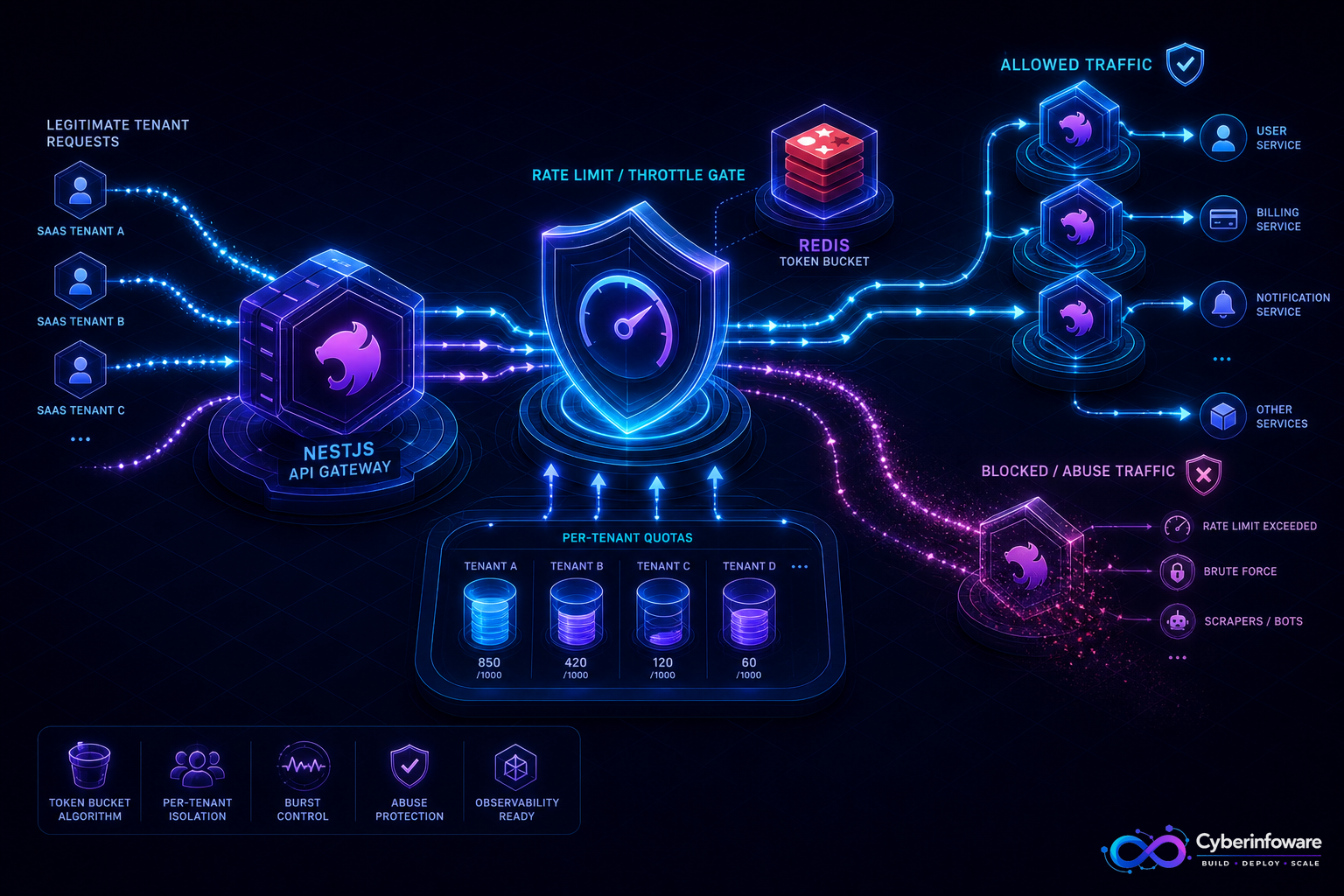
Rate limiting is how a NestJS SaaS stays fair under abuse and noisy neighbors. Without throttling, one scripted tenant — or a leaked API key — can burn CPU, Redis, and database capacity for everyone. At the gateway, Redis-backed counters turn "unlimited" into predictable quotas by IP, user, and tenant.
This guide covers what to throttle first in NestJS, how per-tenant limits differ from global ones, and how Cyber Infoware kits ship an API edge (gateway, Redis, auth) so you are not inventing quotas after the first outage.
Why unlimited APIs fail quietly
- Credential stuffing and scrapers look like "traffic" until pods tip over
- One enterprise tenant running a bulk export can starve smaller customers
- Auth and password-reset endpoints are cheap to attack and expensive to leave open
- Without 429 responses and clear headers, clients retry harder and make it worse
What to rate-limit first in NestJS
- Login / token / password-reset — lowest thresholds, strictest burst rules
- Public or poorly authenticated routes — IP + fingerprint limits before anything else
- Expensive reads — search, exports, report generation, and list endpoints with deep pagination
- Write-heavy APIs — create/update bursts that amplify DB load
- Webhook receivers — accept verified traffic; reject flood attempts early
Global vs per-tenant vs per-user
- Global / IP — stops anonymous abuse at the edge
- Per-user — protects account-level misuse after Keycloak/JWT auth
- Per-tenant — the SaaS essential: one customer cannot exhaust shared Redis, Postgres, or workers
- Combine layers — a plan quota (tenant) plus a short burst limit (user/IP) works better than either alone
A production rate-limit checklist
- Store counters in Redis so limits work across multiple NestJS pods
- Return HTTP 429 with Retry-After (and optional remaining-quota headers)
- Fail closed on auth endpoints; fail open carefully on read-only health checks
- Exclude health/readiness probes from aggressive limits so Kubernetes stays honest
- Log limit hits with tenant/user ids (hashed if needed) for abuse investigations
- Load-test the limiter itself — a slow Redis path should not become your new bottleneck
If every tenant shares one unlimited API, you do not have multi-tenancy — you have a shared outage waiting to happen.
SaaS-specific throttling tips
- Map plan tiers to tenant quotas (starter vs growth vs enterprise)
- Isolate billing and admin routes with dedicated, stricter policies
- Pair rate limits with caching so hot GETs cost less when they do pass
- Watch 429 rates in Grafana next to latency — rising 429s are a product signal, not only a security one
What "done" looks like
Abuse spikes return 429s at the gateway, legitimate tenants keep working, and plan quotas are visible in metrics — not discovered during an incident postmortem. That is the reliability bar modern SaaS buyers quietly assume. Explore packages on cyberinfoware.com/products or contact us to match a kit to your API protection goals.
Explore Cyber Infoware packages
Production NestJS SaaS foundations with commercial licensing — pick the architecture that matches your team.
- NestJS Microservice Starter Kit
Production NestJS microservices — API gateway, Keycloak SSO, RabbitMQ, Docker, Kubernetes, and Terraform.
- Enterprise SaaS Microservices Boilerplate
Full multi-tenant SaaS control plane as NestJS microservices — service-per-DB, billing, audit, notifications.
- Multi-Tenant SaaS Boilerplate
Best-seller NestJS multi-tenant SaaS boilerplate — one API, per-tenant databases, billing, and Keycloak SSO.