Deploy NestJS Microservices on AWS with Terraform: Docker, EKS & Repeatable Infra
A practical guide to deploying NestJS microservices on AWS with Terraform — Docker images, EKS/Kubernetes, networking, and secrets. Learn a repeatable IaC path and how Cyber Infoware kits shorten time-to-production.
- Terraform
- AWS
- NestJS
- DevOps
- Kubernetes
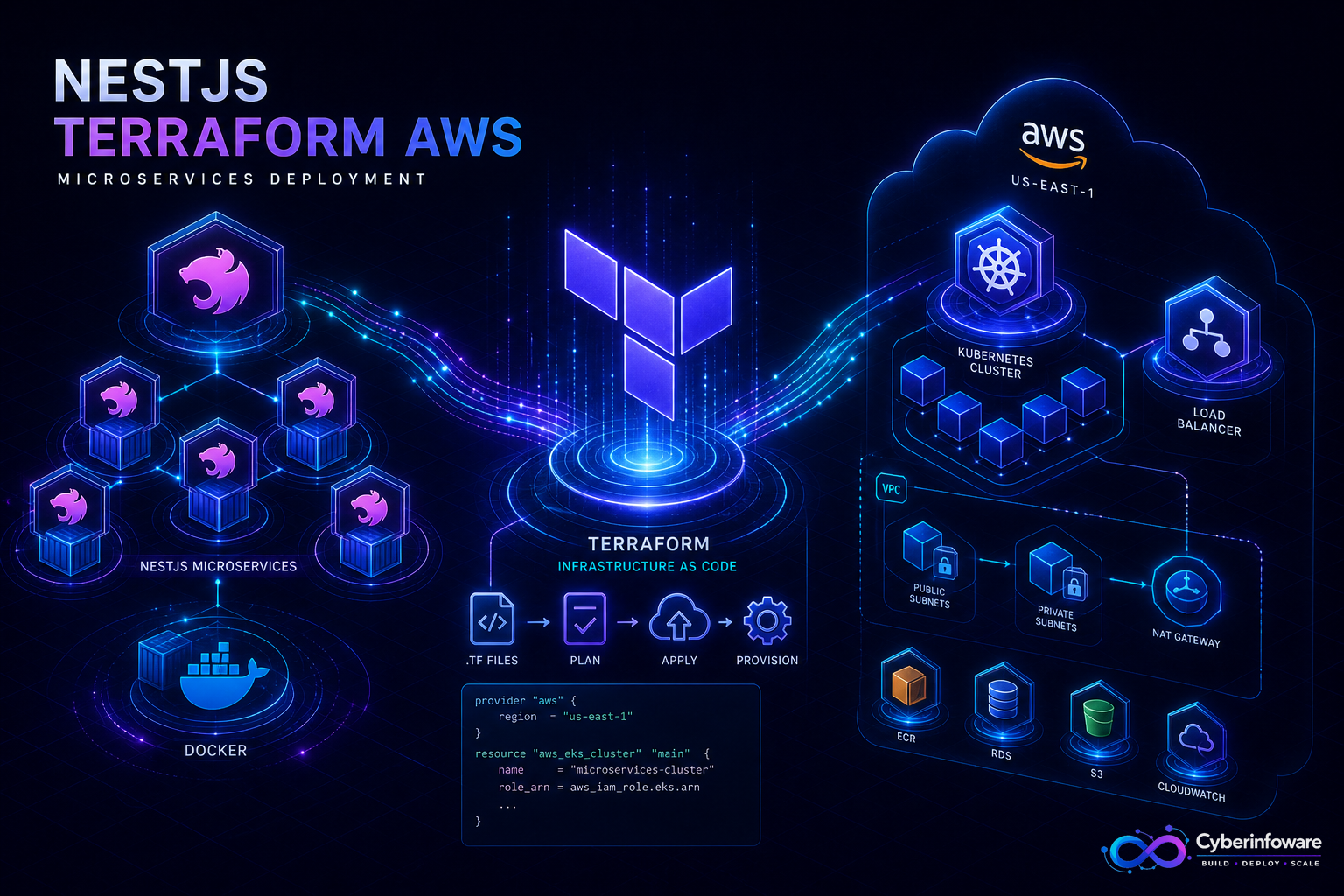
Terraform + AWS turns NestJS microservices from "works on my machine" into a repeatable cloud path: VPC, EKS (or ECS), load balancers, registries, and secrets — versioned as code. For SaaS teams shipping gateways, domain services, Redis, RabbitMQ, and PostgreSQL, that repeatability is what keeps staging and production honest.
This guide covers a practical deploy shape for NestJS on AWS with Terraform, what to automate first, and how Cyber Infoware kits reduce the gap between a working Docker Compose stack and cloud-ready Kubernetes.
Why click-ops AWS breaks NestJS SaaS
- Console-created VPCs and security groups drift between environments
- Manual EKS node groups and IAM roles are hard to audit after incidents
- Secrets pasted into pods become a compliance and rotation nightmare
- Without IaC, "redeploy from scratch" means days — not an afternoon
A practical AWS + Terraform shape for NestJS
- Network first — VPC, subnets, NAT, and security groups sized for gateway + services + data plane
- Container registry — build NestJS Docker images in CI; push to ECR with tagged digests
- Orchestration — EKS (or ECS/Fargate) with Deployments/Services for gateway and domain pods
- Data & messaging — managed PostgreSQL (RDS), Redis, and RabbitMQ (or equivalents) behind private networking
- Ingress & TLS — ALB/NLB + certificates so the NestJS API gateway is the only public edge
- Secrets — AWS Secrets Manager / SSM parameters wired into pods — never bake keys into images
What Terraform should own vs what CI should own
- Terraform — VPC, cluster, IAM, RDS, Redis/MQ, ALB, ECR repos, IAM roles for pods
- CI/CD — build NestJS images, run tests, apply Helm/Kustomize manifests, roll Deployments
- App config — env per environment (tenant defaults, feature flags) via ConfigMaps/Secrets
- Keep apply plans reviewable; never `terraform apply` from a laptop without a remote state backend
Deploy checklist that actually survives production
- Pin image digests in Deployments; avoid floating `latest` in production
- Health probes on NestJS readiness/liveness before traffic shifts
- Remote Terraform state with locking (S3 + DynamoDB or Terraform Cloud)
- Separate workspaces/state for staging and production — never share by accident
- Roll forward with canaries or surge rollouts; keep a one-command rollback path
- Verify OpenTelemetry/metrics after each deploy so "green pods" means healthy traffic
If you cannot recreate your NestJS environment from Terraform and a tagged image, you do not have a deploy process — you have tribal knowledge.
SaaS-specific AWS tips
- Isolate noisy tenants at the data layer (per-tenant DB or strong schema isolation) before scaling nodes
- Put billing and webhook receivers behind clear IAM and rate limits — they are attack surfaces
- Plan multi-AZ for RDS and Redis from day one; multi-region later is a different project
- Cost-control node groups and spot where safe — NestJS CPU spikes should not surprise the bill
What "done" looks like
You open a PR that bumps a NestJS service image digest, CI builds and deploys, Terraform stays for infra changes only, and staging mirrors production networking. That is the delivery bar modern SaaS buyers expect. Explore packages on cyberinfoware.com/products or contact us to match a kit to your AWS deploy goals.
Explore Cyber Infoware packages
Production NestJS SaaS foundations with commercial licensing — pick the architecture that matches your team.
- NestJS Microservice Starter Kit
Production NestJS microservices — API gateway, Keycloak SSO, RabbitMQ, Docker, Kubernetes, and Terraform.
- Enterprise SaaS Microservices Boilerplate
Full multi-tenant SaaS control plane as NestJS microservices — service-per-DB, billing, audit, notifications.
- Multi-Tenant SaaS Boilerplate
Best-seller NestJS multi-tenant SaaS boilerplate — one API, per-tenant databases, billing, and Keycloak SSO.