Zero-Downtime PostgreSQL Migrations for NestJS SaaS: Expand, Backfill & Contract
A practical guide to zero-downtime PostgreSQL schema migrations in NestJS SaaS — backward-compatible changes, safe backfills, rolling deployments, and rollback planning.
- PostgreSQL
- NestJS
- Migrations
- DevOps
- SaaS
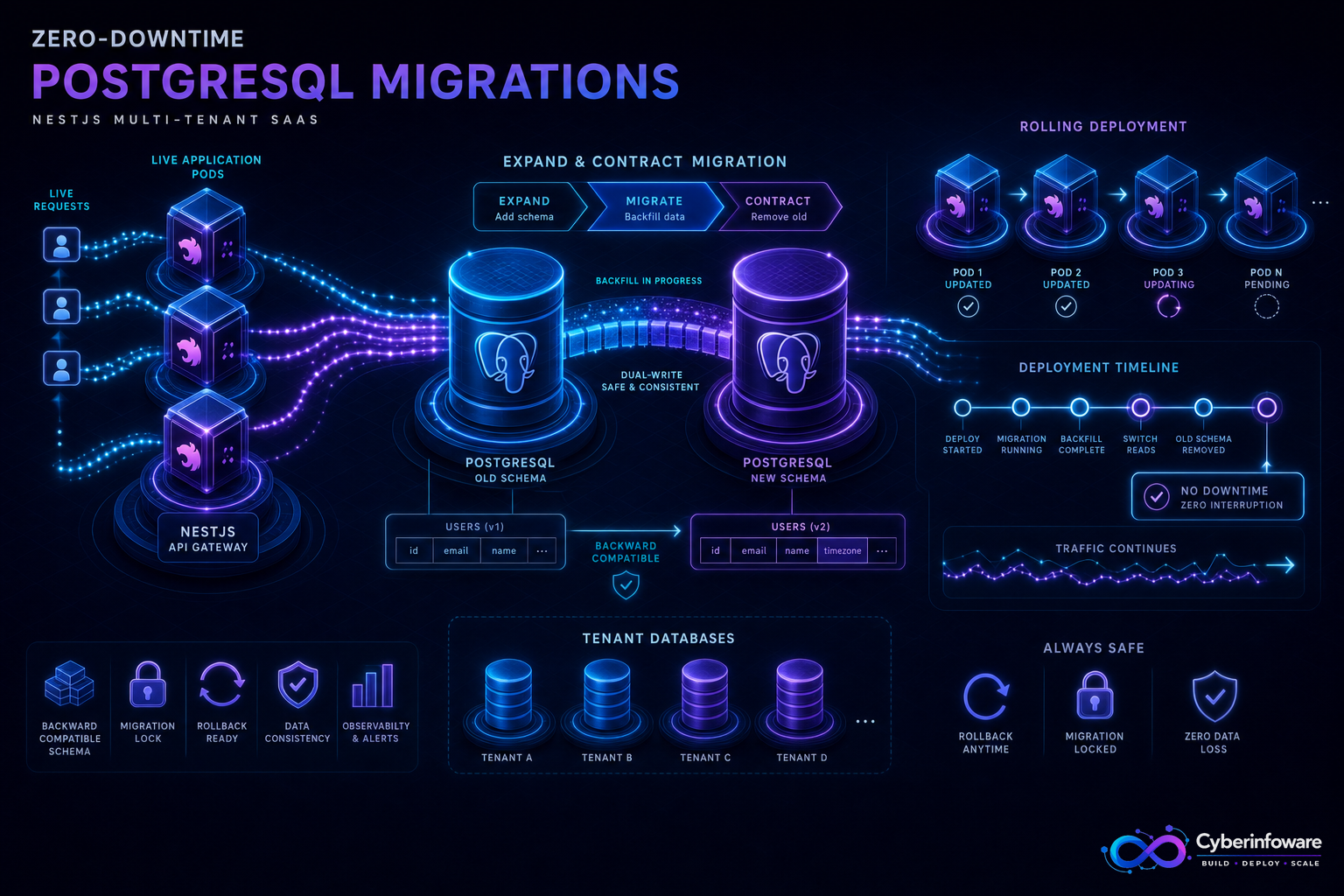
Zero-downtime database migrations are not one clever SQL command. They are a release sequence where the old NestJS version and the new one can safely use the same PostgreSQL schema while pods roll, queues drain, and tenants keep working.
The safest pattern is expand → migrate → contract: add backward-compatible structures first, backfill data without blocking traffic, deploy code that understands both shapes, and remove the old structure only after nothing depends on it.
Why ordinary migrations cause SaaS outages
- Renaming or dropping a column breaks old pods still serving requests during a rolling deployment
- Adding a required column with a large table rewrite can lock writes at peak traffic
- One long transaction can block tenant activity and exhaust the API connection pool
- Running application code and migrations together makes rollback unpredictable
The expand, migrate, contract sequence
- Expand the schema — add nullable columns, new tables, or indexes without removing anything the current release needs
- Dual-write when necessary — temporarily write both old and new fields while versions overlap
- Backfill in batches — migrate existing rows with bounded transactions, checkpoints, and load monitoring
- Switch reads — release code that prefers the new shape but can safely fall back during rollout
- Stop old writes — verify all producers, workers, cron jobs, and integrations use the new contract
- Contract later — remove obsolete columns and compatibility code in a separate release
A safe column rename
Do not rename `full_name` to `display_name` in one migration. Add `display_name` as nullable, dual-write both fields, backfill old rows, switch reads, monitor, and only then remove `full_name`. It takes more than one deployment because that separation is what makes rollback safe.
PostgreSQL changes that need extra care
- Indexes — use concurrent creation where appropriate so normal writes can continue
- NOT NULL constraints — backfill first, validate existing data, then enforce the constraint
- Large backfills — process small primary-key ranges and pause when database load rises
- Type changes — prefer a new column plus controlled conversion over rewriting a large live table
- Foreign keys — add and validate deliberately; validation can be more expensive than the DDL suggests
Deployment checklist for NestJS teams
- Run migrations as an explicit deployment job, not when every NestJS pod starts
- Take an advisory lock so two releases cannot apply the same migration concurrently
- Set statement and lock timeouts; fail safely instead of waiting forever
- Test the old and new application versions against the expanded schema
- Monitor query latency, locks, replication lag, errors, and connection saturation
- Make rollback forward-compatible: reverting code must not require reversing a destructive schema change
A migration is zero-downtime only when the previous application version can coexist with it.
Multi-tenant migration strategy
- For a shared schema, measure lock and backfill impact across the complete tenant dataset
- For per-tenant databases, maintain a migration ledger and roll out in controlled waves
- Canary a small tenant cohort before migrating every database
- Keep tenant routing aware of schema version if databases may temporarily differ
- Alert on partial completion; one skipped tenant database is a production defect
What production-ready looks like
A schema change rolls through staging and production while old and new NestJS pods coexist, backfills are observable and resumable, rollback remains possible, and tenants never see maintenance mode. Explore Cyber Infoware products or contact us to choose a foundation for reliable SaaS delivery.
Explore Cyber Infoware packages
Production NestJS SaaS foundations with commercial licensing — pick the architecture that matches your team.
- NestJS Microservice Starter Kit
Production NestJS microservices — API gateway, Keycloak SSO, RabbitMQ, Docker, Kubernetes, and Terraform.
- Enterprise SaaS Microservices Boilerplate
Full multi-tenant SaaS control plane as NestJS microservices — service-per-DB, billing, audit, notifications.
- Multi-Tenant SaaS Boilerplate
Best-seller NestJS multi-tenant SaaS boilerplate — one API, per-tenant databases, billing, and Keycloak SSO.